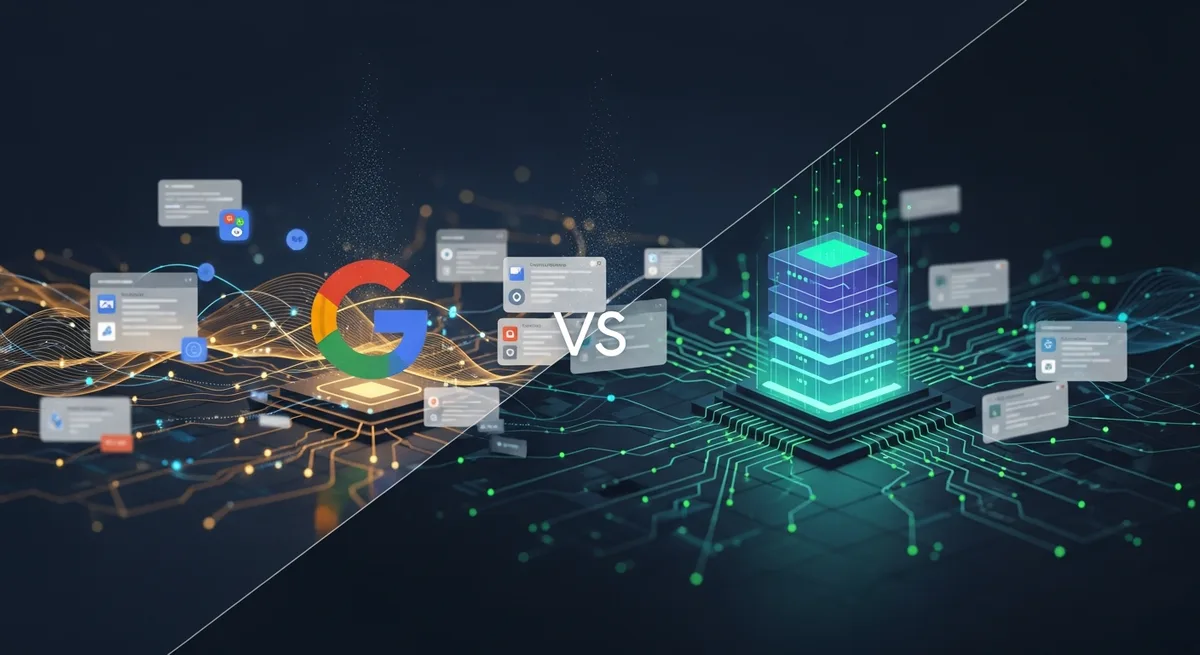
Google Semantic Search Engine vs. Local AI Indexing
Google understands what you mean, not just what you type. That's the claim, anyway.
And honestly? It's mostly true. If you search for "that movie where the guy lives the same day over and over," Google knows you want Groundhog Day. The google semantic search engine has gotten scary good at interpreting intent, mapping relationships between concepts, and serving up answers that match the meaning behind your query rather than the literal string of words.
But here's what nobody in SEO seems to want to say out loud: Google's semantic search was never designed for you. It was designed for everyone. And that distinction matters way more than most people realize, especially when you start thinking about your own browsing history, your own research, your own accumulated knowledge sitting in browser tabs you closed two weeks ago.
I've spent the last six months using a local AI indexing tool called TraceMind alongside Google every single day. The comparison has taught me something I didn't expect: these two approaches to semantic search aren't competitors. They're solving fundamentally different problems. And if you work in SEO, understanding the gap between them might change how you think about retrieval, personalization, and privacy.
How Google's semantic engine actually works (the short version)
Google's semantic search runs on enormous infrastructure. We're talking BERT, MUM, and whatever internal models they haven't publicly named yet, all running across data centers that process billions of queries daily. The system converts your search query into a vector representation, compares it against indexed content that's also been vectorized, and returns results based on meaning-similarity rather than keyword matching alone.
Impressive engineering. No question.
The key thing for SEO professionals: Google's semantic understanding operates at web scale. It needs to work for every possible query from every possible user. So it optimizes for general relevance. The model has been trained on massive, diverse datasets to understand language broadly. When you search "best practices for reducing bounce rate," it knows you're asking about website optimization, not rubber balls.
But general relevance is exactly the limitation. Google doesn't know that when you search "that article about header tags," you're looking for a specific piece you read on Moz three Thursdays ago. It doesn't know your context. It can't. Your browsing history, your research patterns, the pages you've actually visited and found valuable... none of that meaningfully shapes Google's semantic understanding of your query in the way you'd want it to.
Yes, Google personalizes results somewhat. Logged-in search history, location, device. But that's coarse personalization, not semantic indexing of content you've personally consumed.
The local indexing approach is a different animal
Here's where things get interesting for me as someone who researches SEO topics constantly.
Local AI indexing does something Google fundamentally cannot: it builds a semantic search engine from your data, on your machine, using your browsing as the corpus.
TraceMind runs a model called all-MiniLM-L6-v2 directly in the browser (via WebGPU or WASM, depending on your hardware). It generates 384-dimensional vector embeddings for eligible captured pages, stores them in IndexedDB, and lets you search by meaning across that local corpus. When I type "that comparison of link building strategies," it does not search the entire web. It searches pages TraceMind captured from my browsing and can surface the one I remember.
The technical architecture is worth understanding if you're an SEO professional, because it mirrors concepts you already know from Google's approach but applies them at a radically different scale:
- Content extraction happens via Mozilla's Readability library (stripping nav, ads, boilerplate)
- The extracted text gets embedded into vectors locally
- Search combines semantic vector matching with traditional full-text search using something called Reciprocal Rank Fusion
- Core capture, indexing, storage, and search stay on your machine. Licensing contacts TraceMind. Optional Pro Chat sends the question, selected excerpts, titles, URLs, and current chat context directly to the configured AI provider when invoked.
I wrote about how vector embeddings work in the browser if you want the technical deep-dive. The short version: it's the same mathematical concept Google uses, just running locally on a much smaller, more personal dataset.
Why personal history actually demands local
This is the argument I keep coming back to, and I think it's the strongest one.
Google's semantic search engine is optimized for discovery. You don't know what's out there, so you search, and Google helps you find it. That's discovery. It's outward-facing. The entire architecture assumes you're looking for something you haven't seen before, or at least something that exists in the public web's index.
But what about retrieval? What about finding something you have seen?
SEO professionals do an absurd amount of reading. Competitor analyses, algorithm update breakdowns, technical documentation, client industry research. I probably visit 80-120 meaningful pages per day when I'm deep in a project. And the problem isn't finding new information. The problem is finding information I already found once.
Google is bad at this. Not because the semantic technology is bad, but because the architecture is wrong for the job. Think about it:
You read a brilliant article about entity-based SEO six weeks ago. You remember the concept but not the site, not the title, not any specific phrase. You go to Google and search "entity based SEO relationships." You get current results. Maybe good ones. But not that article. The one with the specific framework you wanted to reference in a client deck.
Chrome's built-in history? It only searches URLs and page titles. Completely useless for this scenario. I've written about why you can't find that website you visited last week, and the core issue hasn't changed: browsers treat history as a log, not a knowledge base.
A local semantic index helps because it searches readable text captured from eligible pages, not only titles and URLs. The text. By meaning.
The privacy angle SEO people should care about
I know, I know. "Privacy" sounds like a topic for a different audience. But hear me out.
If you're an SEO professional working with clients, your browsing history is essentially a map of your client portfolio, your competitive research, and your strategic thinking. Every competitor domain you visit, every keyword research session, every analytics dashboard you check... it's all there.
Cloud-based tools that index your browsing and send that data to external servers are a real liability. Not a hypothetical one.
TraceMind's core ML inference, indexing, storage, and search run in-browser. Licensing uses TraceMind's API; optional Pro Chat sends the question, selected excerpts, titles, URLs, and current chat context directly to the configured provider. Free local storage is not passphrase-encrypted. Pro can optionally protect supported local content and create new encrypted backups with AES-256-GCM; new passphrases use 600,000 PBKDF2 iterations and legacy 200,000-iteration data remains readable.
Google's semantic search, by contrast, is the opposite model. Your queries and click patterns can inform personalization and ranking. That is the trade-off, and for general web discovery it may be acceptable. For a personal browsing corpus, I prefer a local-first core with any provider-backed feature disclosed separately.
What Google does better (being honest)
It would be dishonest to pretend local indexing beats Google at everything. It doesn't.
Google's semantic search engine has advantages a local tool simply can't replicate:
Scale of understanding. Google's models have been trained on an incomprehensible volume of text. They understand synonyms, slang, and jargon in ways a lightweight local model won't match. When TraceMind runs all-MiniLM-L6-v2, it's a 22-million parameter model. Google's models are orders of magnitude larger.
Knowledge graph integration. Google connects entities across its entire index. It knows that "Tim Berners-Lee" is related to "W3C" is related to "HTML" is related to "web standards." A local index only knows what you've browsed.
Freshness. Google constantly crawls and re-indexes. Your local index only contains pages you've actually visited. If you haven't read about the latest core update, it's not in your local corpus.
These are real limitations. TraceMind isn't a replacement for Google search and isn't trying to be. The things Google does better are discovery tasks; the things a local index does better are retrieval tasks. Recognizing which problem you're solving at any given moment is half the battle.
A practical workflow that uses both
Here's how I actually use these two systems together on a typical workday. This isn't theoretical. This is last Tuesday.
Morning: client calls for a technical SEO audit. I need to reference a specific crawl budget study I read. Don't remember where. I open TraceMind and search "crawl budget efficiency server response times." It surfaces a Screaming Frog blog post I read in March. Found it in about four seconds.
Midday: researching a new topic I know nothing about (structured data for vehicle listings, weirdly specific client). Google all the way. I need discovery. I need to survey what exists. Local index is useless here because I haven't read anything on the topic yet.
Afternoon: writing a content strategy doc and I need to reference three different articles about topical authority that I read over the past two months. TraceMind again. One search for "topical authority cluster strategy" pulls up all three. With Google, I would have been sifting through hundreds of results trying to identify the specific pieces I'd already read.
The pattern is obvious once you see it. Google for new ground. Local index for your own trail.
What this means for how we think about search
Working in SEO means spending your career thinking about how Google interprets meaning. Entity relationships, search intent, semantic relevance, topic clustering. All of it flows from Google's approach to semantic search.
There's a blind spot in how our industry talks about it, though. We treat search as a single problem with a single solution: type query, get results from the web. The entire SEO framework assumes that model.
Personal knowledge retrieval is a different problem. It needs different architecture. Your past research, your accumulated reading, your professional knowledge base... this stuff lives in your browsing history, and no google semantic search engine is going to index it for you in a way that's both useful and private. The data is too personal, too sensitive, and too contextual.
Local AI indexing isn't competing with Google. It's filling a gap Google can't fill without becoming something most of us wouldn't be comfortable with (and yes, Microsoft tried with Recall, and the privacy backlash was immediate and justified).
My honest take after six months
TraceMind isn't magic. It requires you to have actually visited a page before you can find it again (obvious, but worth stating). The local model is smaller and less sophisticated than what Google runs. Sometimes a search returns results that are semantically adjacent but not what I wanted. It's imperfect.
Still, it's been genuinely useful in ways I didn't expect when I first installed it. The combination of semantic and keyword search through Reciprocal Rank Fusion catches things that either approach alone would miss. Core indexing and search run locally; optional Pro Chat is a separate provider-backed feature.
For SEO professionals specifically: you already understand semantic search better than most people. You know how embeddings work conceptually. You know why intent matters more than keywords. Apply that understanding to your own workflow, not just your clients' rankings. Your personal research corpus is valuable. Treat it that way.
Google built a semantic search engine for the world. What I wanted was one for myself. Turns out those require very different approaches, and I'm glad both exist.